Why is inflation so stubbornly high in
Argentina and low in Japan? In Argentina, consumer prices were 50% higher in
February than a year earlier, the fastest increase since 1991. In Japan over
the same period, inflation was less than 0.2%, equalling the lowest rate since
2016.
The inertia
in both countries is puzzling. Inflation has stayed low in Japan despite a tight labour market (unemployment has remained at 2.5% or below for over a
year) and high in Argentina despite a fast-shrinking economy: its GDP contracted
by more than 6% year-on-year in the fourth quarter of 2018.
The two
countries, of course, have long perplexed economists. In 1950 Argentina’s GDP per
person was three times that of Japan, according to the Maddison Project
database. The Eva Perón charitable foundation, run by the president’s wife,
shipped 100 tonnes of relief supplies to the war-battered Japanese. Thousands
of Japanese migrated in the opposite direction, creating a population of 23,000
Nipo-Argentinos by the end of the 1960s.
But Japan’s GDP per
person eclipsed Argentina’s around 1970 and is now about twice as high,
measured at purchasing-power parity. Its success and Argentina’s failure defied
predictions. Simon Kuznets, who won the Nobel prize in economics in 1971 for
his work on growth, put it best: there are four types of countries in the
world—developed, undeveloped, Japan and Argentina.
Policymakers
in both countries have tried hard to make them macroeconomically “normal”.
After Shinzo Abe became Japan’s prime minister in 2012, the central bank
promised to raise inflation to 2% in about two years by expanding its asset
purchases. And after Mauricio Macri won Argentina’s presidency at the end of
2015, the central bank promised to raise interest rates enough to bring
inflation down below 17% in 2017 and 12% in 2018.
In both
cases, these new policy frameworks seemed to offer a break with the past. However, both governments have been forced to revisit their
targets and their instruments for achieving them. When price pressures proved
more stubborn than Argentina expected in 2017, the government relaxed its inflation targets to bring them closer in line with reality. But
that led investors to lose faith in the authorities’ resolve to tackle
rising prices. In Japan, many commentators think the central bank should lower
its seemingly unreachable 2% inflation target to something more achievable.
In both countries, workers demand that their pay keeps pace with
the price pressures they feel, not the inflation the central bank promises.
During the spring shunto (or wage offensive), Japan’s big companies
and unions discuss wage deals that set a benchmark for other parts of the
economy. Companies like Panasonic, Hitachi and Toshiba have this year offered
increases in base pay of only 0.3%.
Argentina
has a similar set of negotiations known as paritarias. Some
economists expect them to yield wage increases of 30-35% this year, which will
help keep inflation uncomfortably high. In parts of Argentina the school year,
which begins in March, was delayed by striking teachers demanding salary
increases to offset last year’s inflation and this year’s, whatever it turns
out to be.
Argentina’s
inflationary tendencies reflect its long struggle to live within its means. Argentina has
recorded a deficit in its current account in 30 of
the past 40 years. Japan, on the other hand, has run a surplus since 1981 and
is now the world’s biggest net international creditor.
Despite some signs of
change, Japan’s corporations still hoard cash and other financial assets,
rather than splashing out on the higher wages or dividends a rich economy can
afford.
There are
four types of countries in the world: developed, undeveloped—and economies in
each of those two categories who think they are in the other.


 The
rows of hundreds of empty armchairs suggest that something is not quite right.
Airlines are falling out of love with first class. And that is true even of
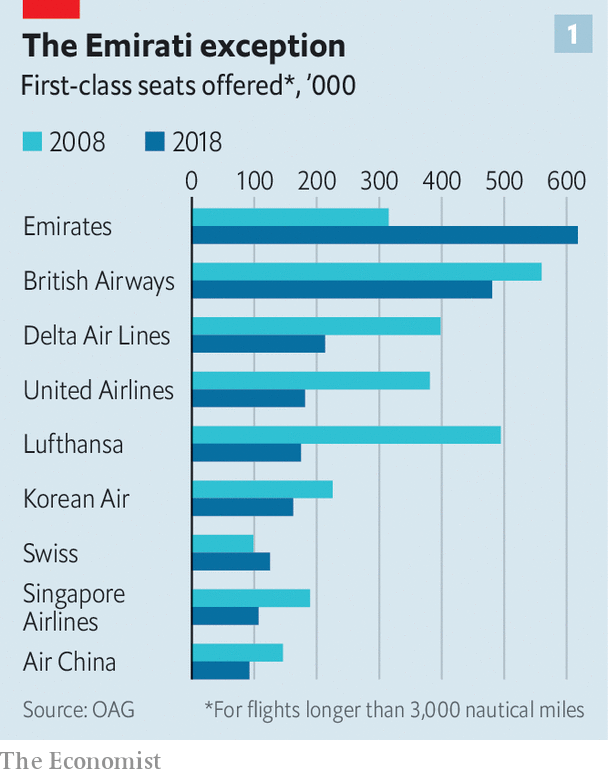
Emirates, which sells far more first-class tickets than any other carrier (see chart 1).
The
rows of hundreds of empty armchairs suggest that something is not quite right.
Airlines are falling out of love with first class. And that is true even of
Emirates, which sells far more first-class tickets than any other carrier (see chart 1). On short-haul
flights, the low-cost model has won. Most “first-class” passengers on these
routes now sit in seats with the same legroom as economy passengers, albeit
with an empty middle seat.
On short-haul
flights, the low-cost model has won. Most “first-class” passengers on these
routes now sit in seats with the same legroom as economy passengers, albeit
with an empty middle seat.